





Share Market Timing in India: NSE & BSE Opening Time
What’s the general knowledge about stock market timings in India? The stock market opens at 9:15 AM and closes at 3:30 PM, simple. Then why such an elaborate blog to understand such a basic...


What’s the general knowledge about stock market timings in India? The stock market opens at 9:15 AM and closes at 3:30 PM, simple. Then why such an elaborate blog to understand such a basic concept?
Table Of Content
Well, let me tell you! Understanding the stock market timings will change your perspective on trading, and you will adapt your strategies accordingly. In general, the stock market timetable might look like trivial information. But, if you master the nuances, it will significantly enhance your trading decisions and efficiency.
In this blog, you will learn everything about the stock market timings in India along with the breakdown of various sessions and special occasions like Muhurat Trading on Diwali.
Understanding Stock Market Timing Basics

The Indian stock market timings are divided into various segments and each one of them serves a specific purpose. Here are some of the key details about these segments:
Also Read: A Beginner’s Guide to the Stock Market: Simple Steps for Success
Stock Market Open Days
- Stock markets in India are open 5 days a week, from Monday to Friday.
- The markets remain closed on weekends and public holidays.
Stock Market Business Hours
| Market Segment | NSE & BSE Timings |
| Pre-Opening Session | 9:00 AM to 9: 15 AM |
Regular Trading Session | Usually, the stock markets follow:Stock Market Open Time: 9:15 AMStock Market Close Time: 3:30 PM |
| Post Closing Session | 3:30 PM to 3:40 PM |
| After Market Orders (AMO) | 3:45 PM to 8:57 AM (on the next day, but may vary slightly by broker) |
Importance of Market Timing in Stock Trading
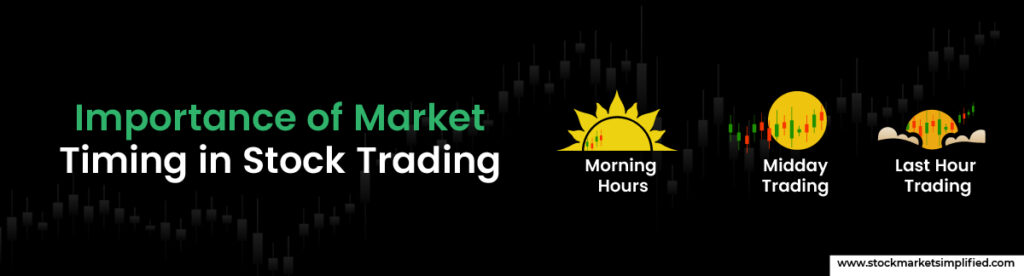
Now you may ask, what is the importance of understanding the stock market timetable? Here are some facts about stock market trading segments that might change your entire trading strategy:
- Morning Hours: The morning hours is the time right after the market opens. During this period, the stock markets are usually volatile. You can try to capitalize on these quick price movements and make good profits.
- Midday Trading: During the day, the market remains rather stable, which is a much better time for medium to long-term investors to make their moves.
- Last Hour Trading: The final hour of trading is again quite volatile as institutional investors square off their trades and adjust their portfolios.
If you align your trading strategy according to these stock market timings, your profits can increase exponentially.
Breakdown of NSE & BSE Trading Sessions

Let’s look at a detailed breakdown of the different trading sessions and their stock market timing on the NSE and BSE.
Pre-Opening Session (9:00 AM – 9:15 AM)
The pre-opening session refers to the first 15 minutes of the trading day from 9:00 AM to 9:15 AM. It is further divided into the following:
- Order Entry Period (9:00 AM to 9:08 AM): You can place buy and sell orders during this period.
- Order Matching Period (9:08 AM to 9:12 AM): The system matches the buy and sell orders during this part of the session to determine the opening price.
- Buffer Period (9:12 AM to 9:15 AM): Once the opening prices are finalized, the system prepares for the regular trading session to commence during this 3-minute buffer time.
The purpose of this pre-opening session is to allow traders to adjust their positions based on overnight news and reduce volatility during the morning hours.
Regular Trading Session (9:15 AM – 3:30 PM)
When the stock market opens at 9:15 AM, the trading activity commences. Throughout the market hours, traders can buy and sell their stocks freely. Here are some key points about this session:
- Continuous Trading: During market hours, orders are placed continuously, and the trades are matched in real-time.
- Volatility: The first and the last hours are usually highly volatile. News and institutional trading drives the market prices at this time. Apart from this, the market remains pretty stable throughout the session.
Post-Closing Session (3:30 PM – 3:40 PM)
The stock market close time is 3:30 PM. But the process doesn’t end there. The stock market timetable consists of another session called the post-closing session. It lasts for 10 minutes from 3:30 PM to 3:40 PM. This is what happens during this time:
- 3:30 PM to 3:35 PM: During this time, the system calculates the closing price based on the weighted average of the last 30 minutes of trading.
- 3:35 PM to 3:40 PM: Traders can place orders at the closing price. These orders are queued for execution at the opening price of the next trading session.
This session is extremely useful for institutional investors, who mostly use it to adjust their positions based on the closing price.
After Market Orders
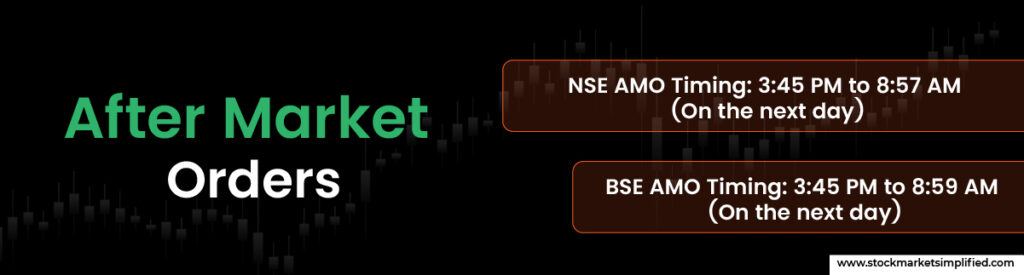
The stock market timings are limited. But the news and events keep shaping up even after the markets close. So, is there a mechanism for a trader to place buy and sell orders even when the markets are closed? Yes! AMO (After Market Orders).
- It allows traders to plan their trades by seeing the global market trends overnight.
- It also helps those who have a busy schedule and cannot trade during regular business hours.
NSE AMO Timing: 3:45 PM to 8:57 AM (On the next day)
BSE AMO Timing: 3:45 PM to 8:59 AM (On the next day)
Note: The timings on the next day may vary slightly by broker
Muhurat Trading

In India, Diwali is the festival of health, wealth and prosperity. Just like businesses thrive during Diwali time, it is believed that trading during the Puja Muhurat period is auspicious.
The stock exchanges arrange for a special trading session on the evening of Diwali, typically lasting for 1 hour. During Muhurat trading, all retail and institutional traders participate enthusiastically.
Stock Market Timings for Different Market Segments
Until now, we have discussed the timings for regular equity trading. However, the stock market timings in India are different for other segments. Here’s the timing for these segments:
| Market Segment | NSE Timings | BSE Timings |
| Equity Derivatives | 9:15 AM to 3:30 PM | 9:15 AM to 3:30 PM |
| Currency Derivatives | 9:00 AM to 5:00 PM (Cross-currency derivatives close at 3:30 PM) | 9:00 AM to 5:00 PM (Cross-currency derivatives close at 3:30 PM) |
| Commodities | 9:00 AM to 11:30 PM(The closing time becomes 11:55 PM during the US daylight saving hours.) | BSE does not directly conduct commodities trading. Commodities trading in India is conducted on platforms like MCX and NCDEX. Timings are usually 9:00 AM to 11:30 PM, extending to 11:55 PM during US daylight saving hours. |
How Stock Market Timings Affect Trading Strategies

Now that you understand all the session breakdowns and how the market reacts during various phases of the day let’s move ahead and address the bigger question. How does knowing about the stock market timings affect your trading strategy? Here’s how:
- Day Trading: Traders who want to capitalize on daily price movements are called day traders. The best strategy for them is to benefit from the intraday volatility during the first and the last hours of the trading session.
- Swing Trading: Swing traders ride the waves created by news and events. They can use the AMO orders to strategize and plan their swing. As a result, they can benefit from the overnight price movements.
- Long-term investing: For long-term investors, it is important to note when the public holidays are. They can plan their portfolio adjustments around market holidays.
To Sum it Up
After the blog, you will agree that stock market timings, a topic that seems quite straightforward, has its own complexities. Whether you are a day trader, a swing trader, or a long-term investor, understanding the stock market timetable is important for all.
Knowing about the session breakdowns, AMOs, and Muhurat trading can be very helpful to leverage your trades and draw maximum benefits.
Disclaimer: The timings mentioned are general schedules. Specific variations may apply due to public holidays, broker policies, or regulatory announcements.