



Understanding Stock Buybacks: How They Affect Share Prices
Introduction to Stock Buybacks Have you heard of IPOs? When a company needs funds to grow its business, it brings a public issue to sell its shares for a price. Once the share gets listed on the...

Introduction to Stock Buybacks
Have you heard of IPOs? When a company needs funds to grow its business, it brings a public issue to sell its shares for a price. Once the share gets listed on the stock exchange, demand and supply keep the market price moving unless the company plans a stock buyback.
Table Of Content
Yes. It is a common practice for companies to buy back their own shares. But what is a stock buyback? How does it affect the share price? How does the market perception change regarding buyback? And why do companies buy back stock in the first place? Don’t worry. We answer all your questions in this blog.
What Is a Stock Buyback?

Stock buyback refers to the practice often used by companies to buy their shares. The price offered for a stock buyback is usually much above the market price of the share. A company can buy back either from the open market or through a tender offer.
Open market purchase
The company buys its shares at the current market price, driving demand upward and leading to a price rise.
Tender offer
The company offers to pay the shareholders a premium over the market price to repurchase the shares.
To put it simply, a company uses its excess cash reserves to purchase its shares. Usually, when a company has excess cash, it is inclined to offer a dividend to shareholders. However, there are several benefits to a stock buyback, like:
- Returning value to the shareholders.
- Reducing the total number of outstanding shares available for trading.
- Consolidating ownership of the company.
- Increasing the value of remaining shares.
- Sparking investor interest in the shares.
- Use surplus cash to bring the undervalued share to its fair value.
Reasons Companies Buy Back Shares

Now, it is a fair question to ask, why do companies buy back stock? What motivation does a company have for buying back its own shares? Well, here are the reasons for the buyback of shares:
Stock is Undervalued
A stock is undervalued because investors do not have enough confidence in it. So, the company initiates a stock buyback to show confidence in its future to the shareholders.
Low Volatility
In a scenario with little volatility, a company can buy back shares to boost investor trust. Lesser shares in the market shoot up the EPS and increase the demand for the stock.
Return the Value to Shareholders
Instead of paying dividends, companies can alternatively provide benefits to shareholders by buying back at a premium.
Improve Financial Ratios
A stock buyback improves all stats that are calculator per share, especially EPS (Earning Per Share) and the P/E ratio.
Prevent Hostile Takeovers
When a huge chunk of a company’s stock is issued for public ownership in the free market, there are more chances of a hostile takeover. Competitors with the necessary means might play badly and accumulate enough shares in a company to own the controlling interest. Stock buyback reduces the number of tradeable shares, limiting the possibility of a hostile takeover.
Save Taxes
Buyback of shares leads to capital gains, which are more tax efficient for shareholders compared to dividends. DDT is 17.65% in India, while long-term capital gains tax is only 10%. LTCG is exempt if the gains are up to Rs. 1 lakh.
Impact of Stock Buyback on Share Prices
Now that you understand the reasons for buying back shares let’s examine how a buyback affects share prices.
Supply and Demand
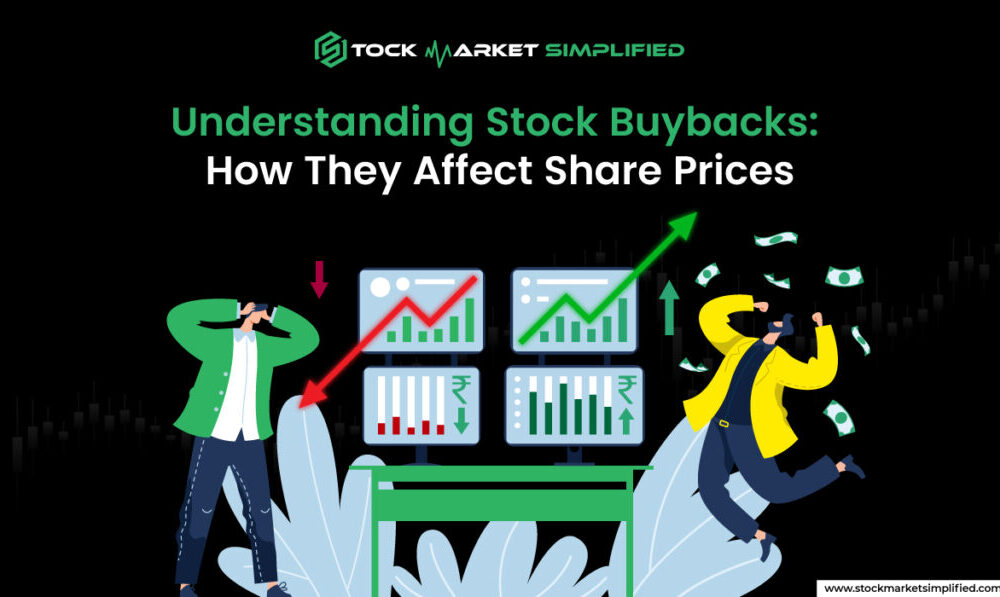
Demand and supply are the forces of free markets, and this holds true for stock markets as well. By initiating a stock buyback, the company creates a high demand for its shares. The stock price increases as investors start buying shares to get the premium on the buyback.
Once the shares are out of the market, the supply of shares reduces, but the demand remains high. It leads to a further rise in stock prices and improves investor confidence.
Effects on Earnings Per Share (EPS)
Profitability is a key indicator that a company is afloat and earning well for its shareholders. However, more outstanding shares in the market mean lower EPS (Earnings Per Share). So, stock buyback is an effective means to increase the EPS.
Investors also see P/E (Price to EPS ratio) to judge whether a stock is overpriced or underpriced. A higher EPS means a lower P/E ratio. Consequently, investors see more potential for an increase in the stock price.
Market Perception and Investor Sentiment
One of the reasons for the buyback of shares is improving market sentiments. A buyback sends a positive signal to the shareholders as the company shows confidence in its own stock. There can be both positive and negative impacts on market sentiments:
Positive Impact
The buyback can be positively perceived as:
- The management is confident in the company’s future.
- Stock is undervalued.
- The company is financially strong.
- The company has surplus cash reserves.
Negative Impact
The buyback can be negatively perceived as:
- Short-term manipulation of share prices.
- The company is artificially trying to lure the shareholders.
- The company’s growth is stagnant. Hence, there is free cash.
- There is no demand for the stock in the markets.
Also Read: Short Selling Explained: How Investors Profit from Market Declines
Long-Term vs. Short-Term Effects
| Short-term effects of Stock Buyback | Long-term effects of Stock Buyback |
| Boost in share pricesImproves financial ratios like:EPSP/E RatioIncreases demand and trade volumesIncreases confidence in the shareholdersRemoves the possibility of hostile takeovers | The long-term effect of the buyback depends on the company’s growth. If the company doesn’t grow and the stock price rises, making it overvalued, its success can be rather short-lived.If a company tries to artificially manipulate share prices through stock buybacks, it can hurt in the long run. |
Risks and Considerations for Investors
Prima facie, stock buyback can look like an ideal strategy. But it has its fair share of downsides as well. So, how do you figure out whether a buyback is worth it? Here are the things you should consider:
- Is the stock undervalued?
- What is the reason for the buyback of shares?
- Short-term tricks to inflate the price artificially.
- Provide value to shareholders in the long term.
- Is the company using free cash reserves or borrowing money to fund the buyback?
Conclusion: Evaluating Buybacks in Investment Decisions
Large companies sometimes use stock buybacks. They are powerful tools for providing value to shareholders, but they also have drawbacks. Investors should know the reasons for the buyback of shares. They should evaluate whether manipulating share prices is a shortsighted decision or if the intention is to provide long-term value to the shareholders.